

If you already own a home, buying a cottage in Muskoka or nearby Simcoe County is less about finding the right lake and more about getting three parties to agree with your plan: your lender, your insurer and the Canada Revenue Agency. Each one asks the same first question in a different way. How will you use the place? I own a home, a waterfront cottage and an investment property myself, and the owners I have seen have the easiest time are the ones who answer that question before they start viewing.
Decide first whether the cottage is for your own use, for family, or for renting, because that choice, along with whether the cottage is winterized and reachable by road all year, drives the down payment, the mortgage insurance options, the insurance policy and the tax treatment. Then get the equity in your current home and your borrowing limits confirmed, budget for Ontario land transfer tax, and talk to your accountant about which property will be your principal residence.
Why it is worth getting right
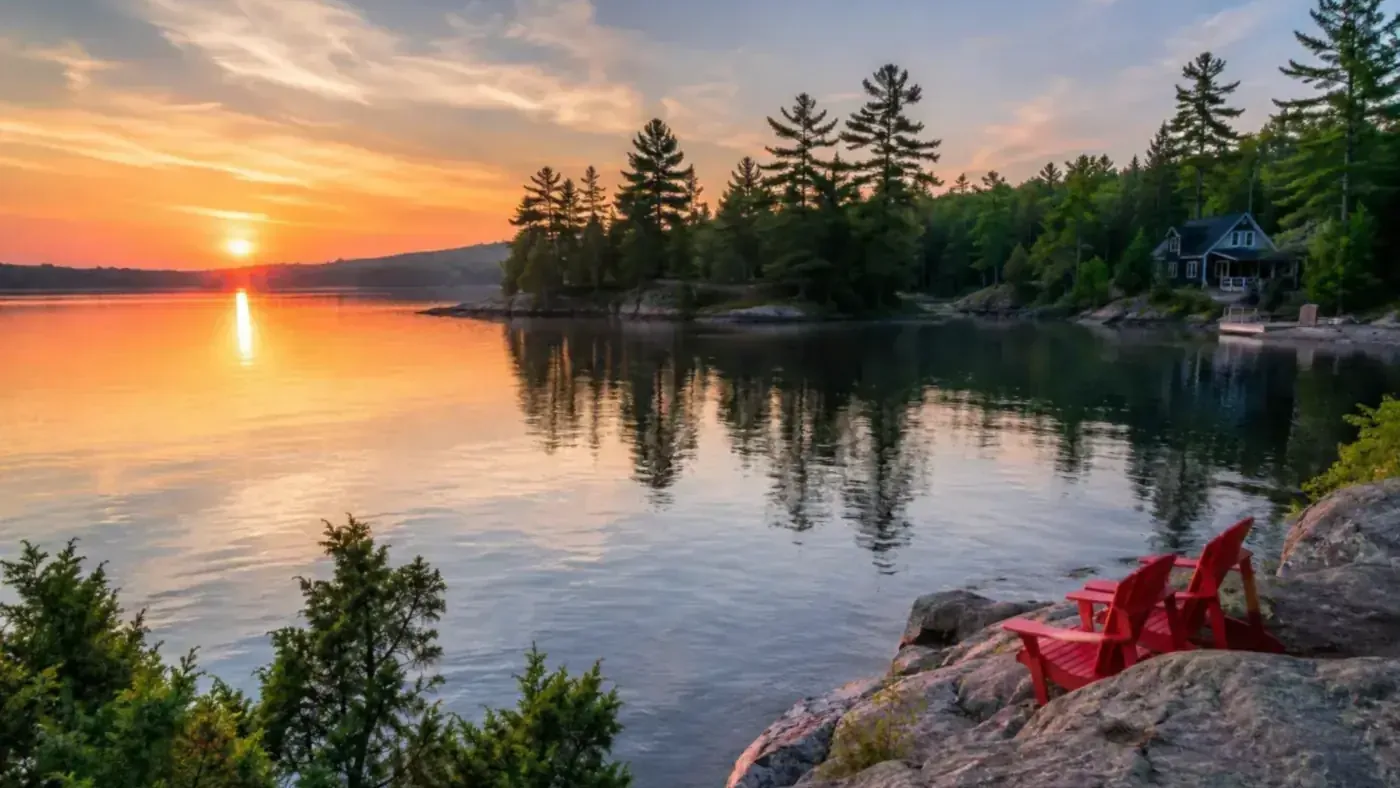
Most of this article is about lenders, insurers and tax, so let me start with the part that does not show up on a statement. A cottage gives you a place where the week actually ends: coffee on the dock before anyone else is up, a swim off your own shoreline, a fire as the light goes, and a long fall weekend when the hills turn red and gold. Unlike a rental, it is set up the way you like, your things are already there, and you never have to check whether your week is available.
It also becomes the place people gather. Friends and family plan around it, traditions form, and the memories made there become part of the return. I own a waterfront cottage myself, and the time on the water is the reason I would do it all again.
It can be sound on the financial side too. A cottage is real property you own and enjoy while you hold it, and with the right financing and tax planning it can sit comfortably alongside your current home in a long-term plan. Like any real estate, values move in both directions, which is exactly why the planning below matters: it lets you enjoy the place without the numbers keeping you up at night.
Start with how the cottage will be used
A cottage your household uses, a cottage you share with family, and a cottage you rent to guests are three different properties on paper, even if they look identical from the dock. Here is how that one decision travels through the rest of the purchase:
| Who decides | What they want to know |
|---|---|
| Mortgage insurers | Whether you or immediate family will occupy it, and whether it has year-round road access or is seasonal or boat access only |
| Your home insurer | How often it is used and whether you rent it out, short or long term |
| Canada Revenue Agency | Whether you ordinarily inhabit it, and whether it earns rental income |
Your insurer needs the full picture. How often the cottage is used, and whether you rent it out, short or long term, must be disclosed to your insurer, and renting it without telling your insurer first can void your coverage (Insurance Bureau of Canada, n.d.). Coverage may also be more limited when a property is left unoccupied for long periods (Insurance Bureau of Canada, 2025), which matters for a cottage that sits empty from Thanksgiving to May.
Planning to rent the cottage out? Short-term rental licensing, tax and insurance are a topic of their own, and I will cover them in an upcoming article. The sections below take the purchase decisions in the order you will meet them.
Using the equity in your current home
Many of the homeowners I speak with plan to fund a cottage down payment with equity, often through a home equity line of credit (HELOC) on the home they already own. Two rules shape how much you can access. At federally regulated lenders, the revolving HELOC portion of a mortgage is limited to 65% of the home's value, and any borrowing above that should be on an amortized (paid down) loan (Office of the Superintendent of Financial Institutions, 2017). The Financial Consumer Agency of Canada puts it from the owner's side: a HELOC combined with a mortgage needs a minimum of 20% equity, and a standalone HELOC needs more than 35% (Financial Consumer Agency of Canada, 2025a).
Those percentages are calculated on today's value, not the price you remember or paid. If your plan rests on a valuation from a few years ago, get a current figure before you count on the number.
A HELOC is flexible, but it carries real risk. Most HELOCs have a variable rate, the lender may change the rate at any time, and paying only the interest will not pay off the loan (Financial Consumer Agency of Canada, 2025a). You also need to pass the mortgage stress test to qualify for a HELOC at a bank (Financial Consumer Agency of Canada, 2025a). For uninsured mortgages at federally regulated lenders, the qualifying rate is the greater of the contract rate plus 2% or 5.25% (Office of the Superintendent of Financial Institutions, 2026).
How much down for the cottage itself
The general Canadian rule is 5% of the first $500,000 of the price and 10% of the portion above that, and 20% if the price is $1.5 million or more (Financial Consumer Agency of Canada, 2025b). With less than 20% down you typically need mortgage loan insurance (Financial Consumer Agency of Canada, 2025b), and the price cap for an insured mortgage has been $1.5 million since December 15, 2024 (Department of Finance Canada, 2024).
For a second home, the property itself matters as much as the price. Mortgage loan insurance in Canada comes from three insurers (Financial Consumer Agency of Canada, 2025b), one public and two private, and each sets its own rules for second homes:
- CMHC. Canada Mortgage and Housing Corporation is a federal Crown corporation (Canada Mortgage and Housing Corporation, n.d.-a). Its second home product requires the home to be intended for homeowner occupancy, to have year-round vehicular access and to be suitable for full-time, year-round occupancy, with a price below $1.5 million (Canada Mortgage and Housing Corporation, n.d.-b).
- Sagen. Less familiar than CMHC, Sagen, previously known as Genworth Canada, describes itself as Canada’s largest private sector residential mortgage default insurer (Sagen, n.d.-a). Its secondary home option needs owner or immediate family occupancy and year-round road access. Its vacation home option is the one built for three season and water access cottages. It accepts a property reached only by boat or on a seasonal road, with no permanent heat source required (a wood stove or fireplace is acceptable), a floating foundation such as one sitting on blocks, and running water that does not have to be drinkable. The maximum loan is 90% of value, so at least 10% down, on a property worth less than $1.5 million (less than $1 million if you borrow 80% or less of the value). The same occupancy rule applies, and investment properties are not eligible (Sagen, n.d.-b).
- Canada Guaranty. Canada Guaranty describes itself as the only 100% Canadian-owned private mortgage insurance company (Canada Guaranty Mortgage Insurance Company, n.d.). Its second home program needs the property to be owner occupied or used by immediate family, winterized and accessible year-round. Non-winterized seasonal properties, islands without bridge access, and rental and investment properties are excluded (Canada Guaranty Mortgage Insurance Company, 2025).
Three season and water access cottages: why the down payment changes
This is where cottage financing differs most from buying in the city. A winterized cottage on a plowed road and a three season cottage you reach by boat can sell for the same price and still need very different down payments, because two of the three insurers will not cover the second one. In practice, Sagen’s vacation home option is the only insured route for a three season, water access cottage (Sagen, n.d.-b; Canada Guaranty Mortgage Insurance Company, 2025; Canada Mortgage and Housing Corporation, n.d.-b).
For illustration only, here is how the minimum down payment changes on a hypothetical $700,000 purchase:
| Type of cottage | Insured route | Minimum down payment |
|---|---|---|
| Winterized, year-round road access, used by you or immediate family | Second home programs from CMHC, Sagen or Canada Guaranty | $45,000: 5% of the first $500,000 plus 10% of the remaining $200,000 (Financial Consumer Agency of Canada, 2025b) |
| Three season, or water access only, used by you or immediate family | Sagen vacation home only | $70,000: 10%, from the 90% maximum loan (Sagen, n.d.-b) |
| Any cottage financed without mortgage loan insurance, including one bought mainly to rent | None | $140,000: 20% (Financial Consumer Agency of Canada, 2025b) |
These are the insurers' minimums, not a promise of financing. In my experience, lenders differ in which insured programs they offer and add their own criteria on top of the insurers', so a water access cottage can call for more than the minimum. Ask your mortgage professional which lenders will finance the specific property before you write an offer. For how to tell whether a cottage really is four season, see what four season actually means in Muskoka.
Qualifying also looks at your whole household. Lenders generally want housing costs at no more than 39% of gross household income and total debt at no more than 44% (Financial Consumer Agency of Canada, 2025c). Canada Guaranty, for example, requires the total debt calculation to include both properties (Canada Guaranty Mortgage Insurance Company, 2025). A licensed mortgage professional can run those numbers with your current mortgage and the new HELOC included before you write an offer.
Land transfer tax on the cottage
Buying a cottage in Muskoka or Simcoe County means paying Ontario land transfer tax on closing. Ontario's rates are marginal: 0.5% up to $55,000, 1.0% to $250,000, 1.5% to $400,000, 2.0% above $400,000, and 2.5% on the portion above $2,000,000 where the land contains one or two single family residences (Ontario Ministry of Finance, 2026b).
The first-time homebuyer refund will not help here. It is not available to anyone who has ever owned a home, or an interest in one, anywhere in the world (Ontario Ministry of Finance, 2026a).
Which property is your principal residence?
This is the question I most want buyers to take to their accountant early. Only one property per family unit can be designated as a principal residence for a given year (Canada Revenue Agency, 2024). A cottage can qualify, and the CRA says that inhabiting a home even for a short period in the year can be enough (Canada Revenue Agency, 2024).
Three points come up often with cottages:
- The one plus rule. The exemption formula adds one year to the years you designate, which lets you treat both homes as your principal residence in a year when you sell one and buy another (Canada Revenue Agency, 2024).
- Large lots. Land beyond one-half hectare is generally not part of the principal residence unless you can show the extra land was necessary for your use and enjoyment of the home (Canada Revenue Agency, 2024). Many of the waterfront lots I see are larger than that.
- Reporting. When you sell a principal residence, you report the sale and the designation on Schedule 3 and Form T2091(IND) (Canada Revenue Agency, 2026).
Any gain on the property you do not designate is a capital gain. The proposed increase to the capital gains inclusion rate was cancelled on March 21, 2025 (Office of the Prime Minister, 2025), and the CRA administers the enacted inclusion rate of one-half (Canada Revenue Agency, 2025). The choice of which home to designate depends on each property's gain, so it is a decision for you and your tax advisor, ideally with records of purchase prices and improvements on both properties.
Don't forget the home you already own
Some owners buy the cottage planning to spend most of the year there. If your current home will sit empty for much of the year, check whether your municipality charges a vacant home tax, and keep any required occupancy declarations up to date.
The federal Underused Housing Tax is not a concern for most owners. Canadian citizens and permanent residents are excluded owners, and no return or tax is required for 2025 and later years (Canada Revenue Agency, n.d.).
The property checks a city or suburban purchase never needed
Once the money and the plan line up, the cottage itself needs a different kind of due diligence from a house in town. The questions I walk buyers through most often each have their own article:
- Whether the cottage is truly usable year-round: what four season actually means in Muskoka
- Who owns the strip along the water: shore road allowances in Muskoka
- Well water and septic: well water testing and treatment
- Buying in the fall: winterizing a water-access cottage before closing
For lake-specific details, from water levels to boat launches, start with my lake guides for Simcoe County and Muskoka.
The order I suggest
- Decide how the cottage will be used: your household, family, rental, or a mix.
- Get a current value on your home and confirm your equity and HELOC limit with your lender.
- Have a licensed mortgage professional confirm the down payment and insurer options for the kind of cottage you want: year-round road, seasonal road or water access.
- Talk to your accountant about the principal residence designation.
- Get insurance quotes early, telling the insurer exactly how the cottage will be used.
- Then shop, with conditions in your offer for the property checks above.
Frequently asked questions
Can I use the equity in my home to buy a cottage?
Often, yes. At federally regulated lenders, a HELOC can be up to 65% of the home's value, and a HELOC combined with a mortgage needs at least 20% equity. You will need to qualify under the stress test, and your current mortgage counts in your debt ratios.
How much do I need for a down payment on a cottage?
It depends on the price, the property and how you will use it. Insured second home programs start at 5% down for year-round, owner-used properties, and one insurer allows seasonal or boat-access cottages at 10% down. A cottage bought mainly to rent generally needs at least 20% down.
Can I get a mortgage on a three season, water access cottage?
Often, but with fewer options. The CMHC and Canada Guaranty second home programs need year-round access and a home that can be lived in all year, and Canada Guaranty specifically requires it to be winterized. Sagen’s vacation home option accepts boat access, seasonal roads and no permanent heat, with at least 10% down, if your lender offers it. Without mortgage loan insurance, plan for at least 20% down.
What land transfer tax do I pay on a cottage in Muskoka?
Ontario land transfer tax, calculated at marginal rates from 0.5% to 2.5% of the price. The first-time homebuyer refund is not available if you have owned a home before.
Can my cottage be my principal residence?
Yes, a cottage you inhabit in the year can be designated, but only one property per family unit can be designated for any given year. Which home to designate depends on the gain on each, so decide with your tax advisor.
Plan it well, then enjoy it
A cottage is a lifestyle purchase and a second property with its own financing, tax and insurance consequences. Getting the order right protects both your weekends and your balance sheet, and leaves you free to enjoy the part that matters most. If you already own a home and are thinking about a cottage on Lake Muskoka, the Severn River or Lake Couchiching, you are welcome to book a call with Kimberly.