

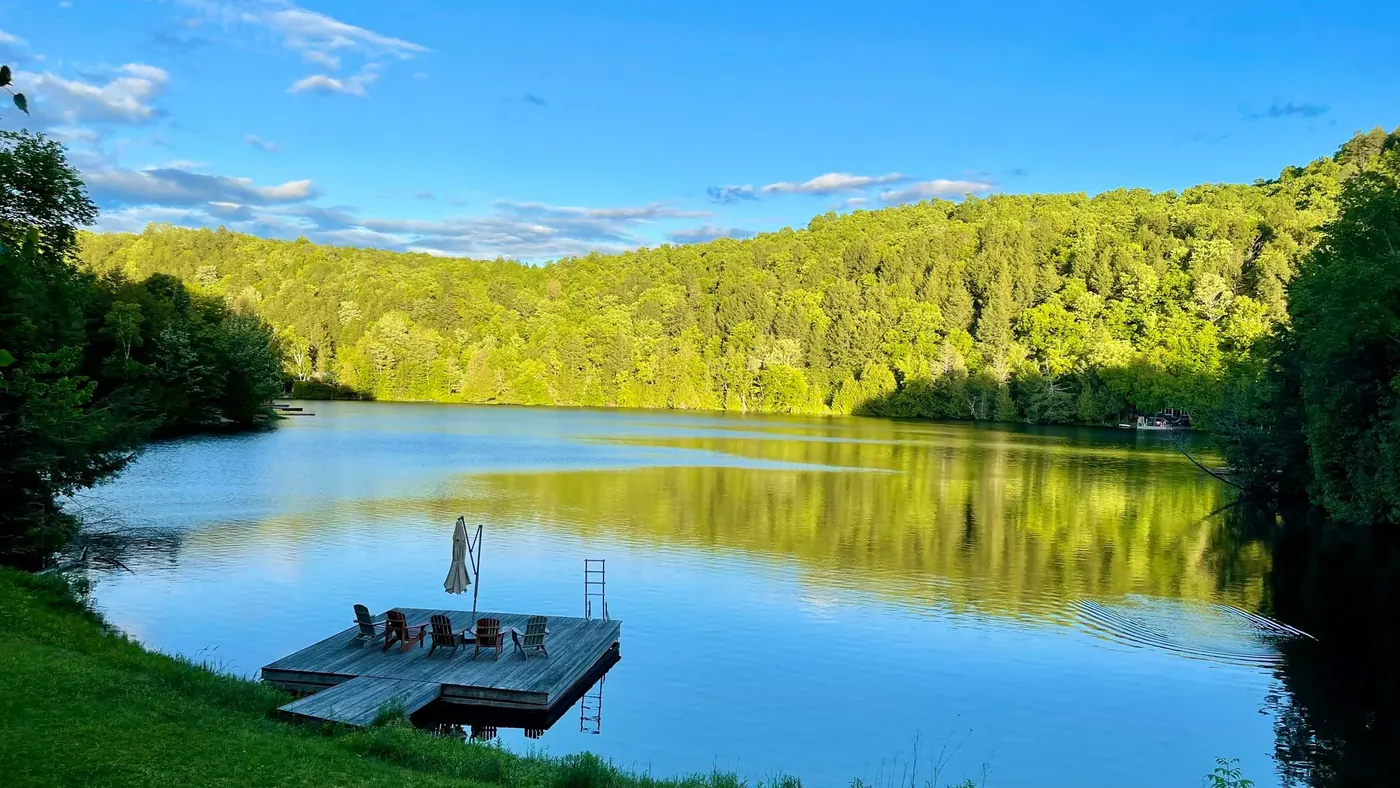
You are standing on a Muskoka cottage lot, looking at the water, and the survey says your property line stops 66 feet short of it. That strip is an original shore road allowance in Muskoka, and until a township passes a by-law closing it and then conveys it, it belongs to the municipality. Ontario's own policy is unusually candid about the consequences: structures were built on these allowances over decades with tacit approval, creating complications with property transfers and mortgages (Ontario Ministry of Natural Resources, 2024).
A shore road allowance is a strip of land, normally 66 feet wide, laid out by Crown surveyors between the upland lot and the water when Ontario's townships were originally surveyed. It is a separate legal parcel owned by the municipality, and it stays a public highway until the municipality passes a by-law closing it, at which point it may be sold and conveyed to the abutting owner. If it is unclosed, the deeded lot stops at its inland edge, and any dock, boathouse or stairs in front of the cottage stands on municipal land. In Muskoka, closures are handled by the six lower tier area municipalities rather than by the District, and a buyer confirms status through the parcel register, a registered closing by-law and conveyance, a reference plan, and the township clerk.
What is a shore road allowance?
When Ontario's townships were originally surveyed, Crown surveyors laid out road allowances between and around lots. Ontario's policy states that a road allowance is normally 66 feet in width, and Muskoka township application forms still use exactly that figure, along with a 33 foot half allowance where an allowance was split between adjoining lots (Ontario Ministry of Natural Resources, 2024; Township of Muskoka Lakes, 2018). That 66 feet was one surveyor's chain, the standard measuring unit in use when the townships were laid out (Township of Muskoka Lakes, 2018).
The one running along water is the original shore road allowance. It is a distinct legal parcel from the lot the cottage sits on, which is why statutory notices describe it so specifically: that part of the original shore road allowance in front of a numbered lot in a numbered concession, in a geographic township, now within a current township.
Under the Municipal Act framework for road allowances, road allowances within a municipality are owned by that municipality and are highways for legal purposes, subject to rights reserved by whoever dedicated them and to interests held by others (Government of Ontario, 2026). Crown shoreline reserves are a separate concept, ungranted Crown land that stays under the province (Ontario Ministry of Natural Resources, 2024). Do not treat the two as interchangeable.
Open, closed, or closed and conveyed
Three states, and only one of them puts the strip in your name.
Open and unclosed. The strip remains a public highway owned by the municipality. This is true regardless of how long the abutting owner has mowed it, docked on it, planted it or paid taxes on the cottage behind it. Long use does not create title in Ontario.
Closed. The municipality has passed a by-law stopping up and closing the allowance. This removes its status as a highway but does not by itself put it in private hands.
Closed and conveyed. Once closed, the municipality may sell and transfer the parcel to the abutting landowner. Only at this point does the strip merge into the ownership of the cottage lot, and even then it can carry reservations, easements or utility rights that survive the transfer.
You will also see part of an allowance closed and part of it merely closed rather than sold. That structure is not arbitrary. Submerged portions of a road allowance require Ministry of Natural Resources consent under the Municipal Act before the municipality can deal with them, so the dry land above the high water mark and the flooded land below it are often handled as separate numbered parts on the same plan (Government of Ontario, 2026).
Who closes a shore road allowance in Muskoka?
The area municipality does. Muskoka is a two tier structure: the District Municipality of Muskoka is the upper tier, responsible for District roads, water and wastewater infrastructure and District wide planning policy, and beneath it sit six area municipalities, being Bracebridge, Gravenhurst, Huntsville, Georgian Bay, Lake of Bays and Muskoka Lakes. Shore road allowances belong to the area municipality, and it is the area municipality that passes the by-law to close and sell one.
The process is broadly consistent across the six, though the details differ. An application goes to the township with a fee, staff circulate it internally and to agencies, abutting owners and anyone with a demonstrated interest are notified, a reference plan of survey by an Ontario Land Surveyor is deposited at the land registry office differentiating the parts above and below the high water mark, a staff report goes to Council, public notice is published, and Council passes the closing and selling by-law. The applicant then pays the purchase price plus survey, appraisal, legal and registration costs, and the municipality's solicitor delivers the deed.
Two details are easy to miss. Townships publish timelines running from several months to about a year, and applicants are typically given a fixed window after the by-law passes to complete the purchase. And where a lot was created by a registered plan of subdivision, a concurrent deeming by-law may be required so the acquired allowance merges with the property rather than sitting alongside it as a separate parcel (Town of Gravenhurst, 2025).
Closures are also refusable. Published grounds for refusal include an allowance in a flood plain, one that is not township owned, one that provides access to other properties, one below the high water mark on a non controlled water body, one containing a portage trail, one with historic or cultural value, one needed for municipal recreation, one that would negatively affect neighbours, or one that conflicts with the Official Plan.
What does it cost to buy out a shore road allowance?
Not one cheque, and not a single provincial number. Expect an application fee to the township, a legal retainer for the municipality's solicitor, the cost of a reference plan from an Ontario Land Surveyor, advertising and registration costs, and the purchase price of the land itself.
The purchase price is set by council policy, and the pricing structure genuinely differs between townships. Some price per running foot of shoreline and apply a premium on the larger lakes (Town of Gravenhurst, 2025). Others price per square metre. Current rates live in each township's fees and charges by-law, which is revised, so the only reliable figure is the one the township quotes you today. Two cottages a few kilometres apart, one in Gravenhurst and one in Georgian Bay, can face different processes, different pricing formulas and different timelines for the same 66 foot strip.
What it means for title, docks, privacy and financing
If the allowance is unclosed, the deeded lot stops at its inland edge, and the dock, boathouse, stairs or shoreline retaining wall in front of the cottage is standing on municipally owned land. That does not make the structure illegitimate, but it does mean the township has a say in what happens to it, and a buyer should ask what the township currently permits rather than assume the arrangement transfers untouched. That sits on top of the five layers of dock approval that apply to shoreline work anyway.
There is a third layer beneath both. Under the Beds of Navigable Waters Act, where the Crown granted waterfront land, the bed of a navigable water body is presumed to have stayed with the Crown unless there was an express grant (Ontario Ministry of Natural Resources, 2026). General wording such as together with the woods and waters therein is not an express grant (Ontario Ministry of Natural Resources, 2026). Ontario's policy calls the result natural severance, where the owner's land is effectively split into separate parcels with Crown controlled water between them.
So the honest answer to what do I own on a Muskoka waterfront lot has three parts: the lot ends at the inland edge of the shore road allowance if it is unclosed, the allowance belongs to the township until closed and conveyed, and the lakebed beyond the water's edge is presumed Crown unless expressly granted. When Kimberly walks a Muskoka waterfront property with a buyer, the first thing she looks for on the survey is whether a strip sits between the lot line and the water, because privacy, dock plans and financing all follow from that answer.
On financing and resale, keep it factual rather than alarming. Ontario's own policy names transfer and mortgage complications as a known consequence of historical building on unclosed allowances, so lenders and lawyers ask questions. That is a reason to establish status early, not a reason to walk away. Where the cottage is also marketed as year round, pair this check with what makes a cottage four season, because both questions are answered by documents rather than by the listing description.
How to verify status before you offer
- Have your real estate lawyer pull the parcel register for the PIN and read the legal description. Does it include the original shore road allowance, or does it stop at the lot line?
- Look for a registered closing by-law and a registered transfer of the allowance parcel to a prior owner. A closure without a conveyance is not the same thing as ownership.
- Look for a reference plan describing the allowance parts. In Muskoka these carry a 35R prefix, as in Part 1 on Plan 35R and a number.
- Confirm with the area municipality's clerk. Township application forms require a solicitor or an Ontario Land Surveyor to confirm township ownership, which tells you how the township itself treats the question.
- Where any portion sits below the high water mark, ask whether Ministry of Natural Resources consent applies to that part.
- Order a survey where the boundary matters, because what a survey actually shows is the location of improvements relative to the boundary, which title insurance does not do.
- Ask the seller and the township for copies of any permits or permissions attached to existing shoreline structures, and whether they transfer.
Ontario's land registration records are held electronically, and land and property record searching runs through the provincial system, with full registration access limited to authorized professionals such as lawyers, conveyancers and surveyors. This is a lawyer's job, and it belongs at the front of the transaction.
Common questions
How wide is a shore road allowance in Ontario?
Ontario's own policy describes a road allowance as normally 66 feet in width, and Muskoka township application forms refer to a 66 foot shore road allowance with a 33 foot half allowance where the allowance was split between adjoining lots. That 66 feet was one surveyor's chain, the standard measuring unit used when Ontario's townships were originally laid out. The actual dimension on a given property is confirmed by the registered plan and by a reference plan prepared by an Ontario Land Surveyor.
Does long use of a shore road allowance create ownership?
No. Until the municipality passes a by-law closing the allowance and then conveys it, the strip remains a public highway owned by the municipality, regardless of how long the abutting owner has mowed it, docked on it or paid taxes on the cottage behind it. Ontario's own policy acknowledges that structures were historically built on these allowances with tacit approval, and that this creates complications with property transfers and mortgages. Ownership changes only through the closure and conveyance process.
Who closes a shore road allowance in Muskoka?
The lower tier area municipality does, not the District. Muskoka is a two tier municipality: the District Municipality of Muskoka sits above six area municipalities, being Bracebridge, Gravenhurst, Huntsville, Georgian Bay, Lake of Bays and Muskoka Lakes (District Municipality of Muskoka, 2025). Each of those six runs its own closure process with its own application, pricing method and timelines, which is why the answer to what it costs and how long it takes genuinely differs across a township line.
How do I check whether a shore road allowance has been closed?
Have your real estate lawyer pull the parcel register and read the legal description: does it include the original shore road allowance, or does it stop at the lot line. Then look for a registered closing by-law, a transfer of the allowance to a previous owner, and a reference plan describing the parts, which in Muskoka carries a 35R prefix. Finish by confirming with the area municipality's clerk, since township application forms require a solicitor or an Ontario Land Surveyor to confirm township ownership.
Can I build a dock if the shore road allowance in front of my cottage is open?
It is not automatic. Where the allowance is unclosed, a dock stands on municipally owned land rather than on your own, so the township's position matters on top of the usual conservation authority, provincial and federal approvals. Where any part of the allowance sits below the high water mark, the municipality also needs Ministry of Natural Resources consent before it can deal with that portion. Ask the township what it currently permits before assuming an existing dock can be replaced or enlarged.
Ask the question early, not at closing
A shore road allowance is not a reason to avoid a cottage. It is a reason to ask one specific question at the start of the process, when there is still time to get an answer that changes nothing about your plans. If you are looking at Muskoka waterfront properties, planning shoreline work, or want to understand how the buying process works on a lot where title and water do not meet, that conversation is worth having before you write. You are welcome to book a call with Kimberly and bring the survey with you.