

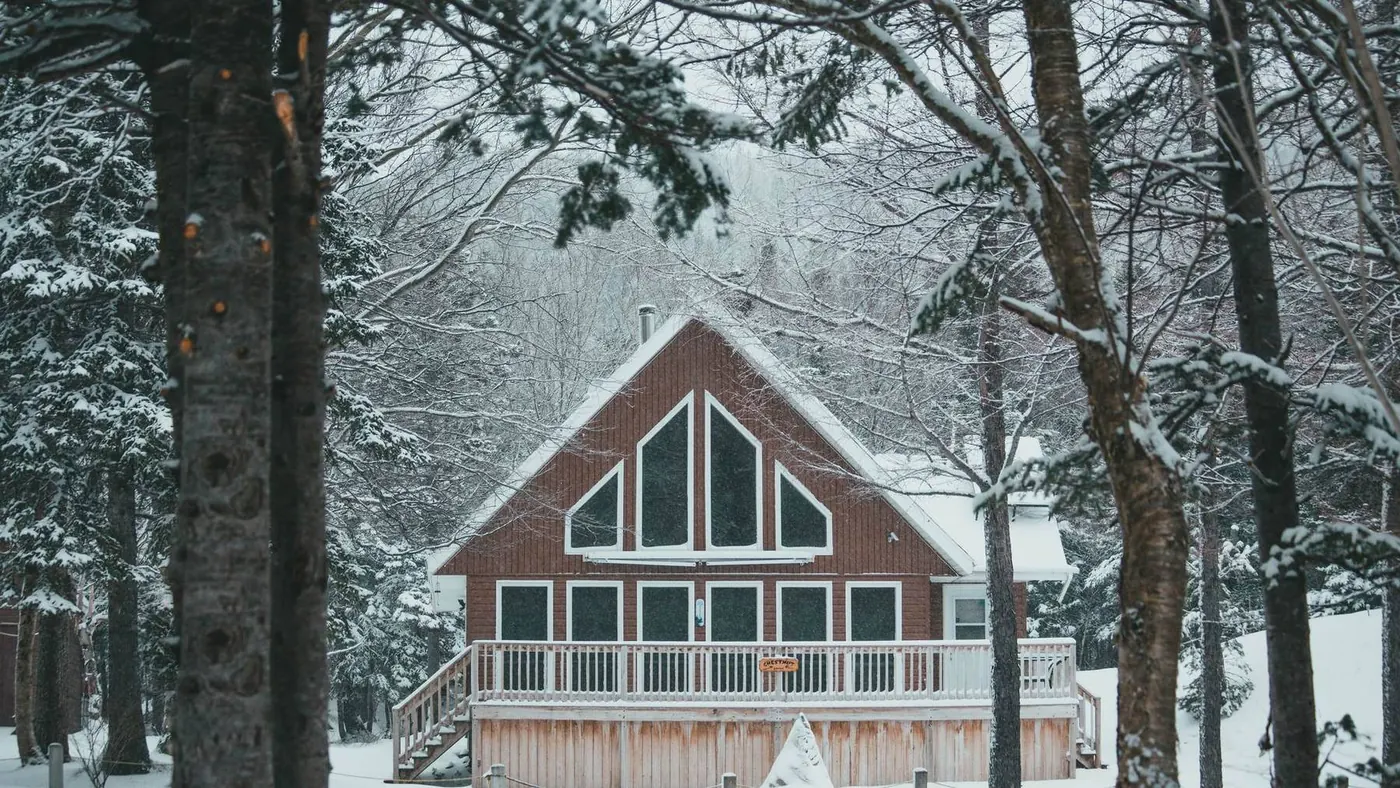
A listing that says four season is making a claim, not stating a fact. Ontario has no legal definition of a four season cottage in Muskoka, and nothing in the Building Code or in provincial regulation uses the term. What does exist is a set of five independently verifiable systems, and the closest thing Ontario law has to a definition sits inside the Building Code's energy standard, which applies to housing intended for occupancy on a continuing basis during the winter months.
Four season and three season are market and lender shorthand, not legal classifications in Ontario. A cottage is genuinely year round when five systems each work in February: an insulated and air sealed envelope with a heating system sized for the climate, a foundation below the frost line or otherwise frost protected, a water supply that does not depend on an open lake intake, a sewage system permitted for year round loading, and dependable winter road access. The two that buyers miss most often are the last one and its consequence, because CMHC's Second Home mortgage loan insurance requires year round vehicular access and a property suitable and available for full time year round occupancy, and seasonal properties are not eligible under it. Verify each system with permits, records and the area municipality rather than with the listing description.
What does four season actually mean in Muskoka?
There is no statutory answer, so start with the closest thing Ontario has. The Building Code's supplementary standard SB-12, which sets energy efficiency requirements for housing, applies to a residential building or part of a building intended for occupancy on a continuing basis during the winter months (Town of Gravenhurst, n.d.). That phrase is the Code's own trigger for winter performance, and it is a far better test than any marketing term.
Read that way, four season is not a feature. It is an intention that has to be backed by five systems: envelope and heat, foundation, water, sewage, and access. Each is separately verifiable, each has a paper trail, and a cottage can fail on one and pass on four.
Muskoka is a two tier municipality, which matters when you go looking for that paper trail. The District Municipality of Muskoka is the upper tier, and beneath it sit six area municipalities: Bracebridge, Gravenhurst, Huntsville, Georgian Bay, Lake of Bays and Muskoka Lakes (District Municipality of Muskoka, 2025). Building permits, zoning and most of the records you will want come from the area municipality the property sits in, not from the District.
Envelope, heat and the Code's winter test
Ontario is divided into two energy zones by heating degree days, and Muskoka falls in the colder of the two. In practical terms, a house built to current requirements carries ceiling insulation in the R50 range and wall assemblies well beyond anything a 1960s cottage was framed for. The exact prescriptive values change with each edition of the Code, so a designer confirms the current package. The principle does not change: a cottage built for July was not built for February, and closing that gap is real work.
Air sealing matters as much as insulation, because a leaky envelope drives moisture into cold assemblies and produces condensation, attic frost and rot. The Code's supplementary standard SB-1 publishes design temperature, degree day, snow load and rain load figures for every Ontario municipality, and your designer works from the row for the township you are buying in.
Heating usually means propane, a cold-climate rated heat pump, electric resistance heat, a wood stove, or some combination. What matters for a buyer is less the brand than four answers: what is the primary heat source, how old is it, is there a second source if the first fails, and what happens in an extended winter outage.
Foundation, frost and what sits under a Muskoka cottage
The Building Code requires footings to bear below the local frost line, or to be protected against frost by other means. The design depth is set locally, which makes it a question for the area municipality's building department rather than a single provincial number. Do not accept a figure quoted from an article, including this one.
Muskoka's geology is easy to misread here. Shallow soils and exposed Canadian Shield bedrock mean many older cottages sit on rock, piers or shallow footings by necessity rather than by cost cutting. That is regional building reality, not automatically a defect. What it does mean is that foundation type is the single largest variable in the cost of converting a seasonal cottage to year round use.
Four broad types, and what each implies:
- Piers or posts on grade. The most common arrangement under an older three season cottage. Typically not frost protected, with an open crawl space and exposed plumbing.
- Unheated crawl space. Workable, but the insulation has to sit at the floor plane or the crawl space has to be insulated and conditioned at the perimeter. Plumbing routing usually decides which.
- Full basement below the frost line. The most straightforward path to year round use.
- Slab on grade. Needs a frost protected design, and the Code addresses insulation for heated slabs.
Water and septic when the ground is frozen
Ask two questions about water. Where does it come from, and what happens to that line when the lake freezes. A drilled well with the supply line buried below the frost line and the pressure system inside heated space behaves like a house. A lake intake is a seasonal system unless someone has deliberately engineered it not to be, which means a line set deep enough to stay below the ice, heat traced where it comes ashore, and designed to drain.
Ontario has kept water well records since 1899, and they show construction method, location, depth, pumping test results and general water quality information (Ontario Ministry of the Environment, Conservation and Parks, 2026). Ask for the record. A cottage with no record on file is not automatically a problem, but it is a question. Private wells are not routinely required by provincial regulation to be sampled, so the owner carries responsibility for testing and treating a private well on the local public health unit's guidance.
Sewage systems are regulated under Part 8 of the Ontario Building Code and require a permit. Clearance distances published by the Township of Muskoka Lakes for a Class 4 leaching bed include 15 metres from a well with a 6 metre casing, 30 metres from a well without one, 30 metres from surface water, 3 metres from property lines and 5 metres from dwellings (Township of Muskoka Lakes, n.d.-a). Note the tension: the Code minimum is 15 metres from surface water, while Muskoka Lakes By-law 2015-77 keeps any part of a leaching bed at least 30 metres from the high water mark. Municipal planning policy is stricter than the Code floor.
Muskoka Lakes also runs a sewage system maintenance inspection program that ranks properties by risk. Waterfront systems over 30 years old, short term rental properties, and systems with no permit record on file are classed high risk (Township of Muskoka Lakes, n.d.-b). That last category is worth sitting with: a septic system with no permit record is not just a private worry, it is a named municipal risk category. Which tier issues sewage permits differs between Muskoka's area municipalities, so confirm with the township the property sits in.
Is the road plowed all winter?
This is the question buyers skip, and it is the one with money attached. Ontario's minimum maintenance standards for municipal highways classify roads from Class 1 to Class 6 by posted speed and average annual daily traffic, and the regulation does not apply at all to Class 6 highways. So a road being municipal does not by itself mean a plow comes to a defined standard.
Then there is the standard itself. The Township of Muskoka Lakes maintains its own roads to a snow packed condition, treated mainly with sand and with salt used sparingly for ice or freezing rain (Township of Muskoka Lakes, n.d.-c). It maintains two District roads on the District's behalf to a bare pavement standard, and the Ministry of Transportation maintains Highway 141 and Lake Joseph Road (Township of Muskoka Lakes, n.d.-c). On one drive from Gravenhurst to a cottage near Port Carling you can cross three different winter maintenance standards, which is why winter access here feels inconsistent to people arriving from the city. The Township does not maintain private property, including driveways.
When Kimberly reviews a listing that claims year round access, the first document she wants is not the feature sheet but the road agreement, because a private road with no funded plowing arrangement changes what the property is. Ask the area municipality three things: is the road assumed by the township or private, is it on the winter maintenance route, and if it is private, who plows it, under what agreement, and at what cost to each owner.
What a seasonal classification does to insurance and financing
Here is the clearest verifiable statement about why any of this matters financially. CMHC's Second Home mortgage loan insurance product requires the property to have year round vehicular access, including for homes on an island, whether by mainland road, bridge or ferry, and to be suitable and available for full time and year round occupancy (Canada Mortgage and Housing Corporation, n.d.). Seasonal properties are not eligible under that product. Insured financing also carries maximum loan to value limits and a property price ceiling, both set federally and both revised periodically.
Mortgage default insurers each apply their own property eligibility criteria to recreational and second properties, and those criteria turn heavily on year round access and year round habitability. The category names differ between insurers and change over time. A licensed mortgage professional who regularly finances cottage property is the right person to ask, and the right time is before you write an offer.
Insurance is set by individual insurers rather than by regulation, so treat it as a list of questions for a broker: limits on how long the property can sit unoccupied, conditions around freezing and water damage, any requirement to maintain heat, inspection requirements for wood stoves and other solid fuel appliances, and how the insurer treats road or water access.
How to verify a four season claim before you offer
- Ask the seller what four season means for this property and which specific upgrades support the claim.
- Request building permits, final inspection sign offs, the sewage system permit and septic maintenance records, the well record and recent water test results.
- Confirm foundation type, and have a contractor experienced in cold-climate retrofits look at it where it matters.
- Confirm the primary heat source, its age and fuel, whether a second source exists, and what happens in an extended outage.
- Trace the water line from source to fixture, and establish whether it is a well or an intake and whether it drains.
- Put the three road questions to the area municipality and get the answer in writing.
- Ask a mortgage professional and an insurance broker for terms in writing, based on your actual occupancy pattern.
- On waterfront, check whether the shore road allowance has been closed and conveyed, confirm dock approvals and seasonal removal history, and be clear about waterfront, water view and water access, because they are different purchases.
Common questions
Is four season a legal classification in Ontario?
No. Four season and three season are market, insurance and lender shorthand, and neither is defined in the Ontario Building Code or in provincial regulation. The closest thing in Ontario law is the Building Code supplementary standard SB-12, which applies to housing intended for occupancy on a continuing basis during the winter months. That is why the reliable test is not the label on the listing but five systems: envelope, foundation, water, sewage and access.
Can I get a mortgage on a three season cottage in Muskoka?
Financing exists for seasonal properties, but the options narrow. CMHC's Second Home mortgage loan insurance product requires year round vehicular access and a property that is suitable and available for full time year round occupancy, and seasonal properties are not eligible under it. Mortgage default insurers each apply their own property criteria and revise them periodically. A licensed mortgage professional who regularly finances recreational property is the right person to ask before you write an offer.
How do I confirm a Muskoka cottage has year round road access?
Ask the area municipality three questions: is the road assumed by the township or is it private, is it on the winter maintenance route, and if it is private, who plows it, under what agreement and at what cost. Ontario's minimum maintenance standards for municipal highways classify roads from Class 1 to Class 6 and do not apply at all to the lowest class, so a road being municipal does not by itself mean a plow comes. Township roads in Muskoka Lakes are maintained to a snow packed condition rather than to bare pavement.
Does a cottage need a drilled well to be four season?
Not strictly, but it is the most straightforward answer. A drilled well with the supply line buried below the frost line and the pressure system inside heated space behaves like a house. A lake intake is a seasonal system unless someone has deliberately engineered it otherwise, with the line set deep enough to stay below the ice and designed to drain. Ask for the well record, which Ontario has kept since 1899, and have the system assessed by a licensed contractor.
What does converting a three season cottage to year round use involve?
It usually means work in five areas at once: insulation and air sealing to current Building Code levels, a foundation that is below the frost line or otherwise frost protected, a water supply that does not depend on an open lake intake, a sewage system permitted and sized for year round loading, and dependable winter access. Each of those has its own permit path through the area municipality's building department. Get contractor quotes and a permit review before you buy rather than after.
Bring the questions before the offer
The best time to find out that a cottage is a summer building is before you own it, and every one of these systems can be checked with records that already exist. If you are looking at cottage properties across Muskoka and want a straight read on whether a specific property is genuinely year round, that is a conversation worth having early. You are welcome to book a call with Kimberly and go through the five systems on a property you are considering.