

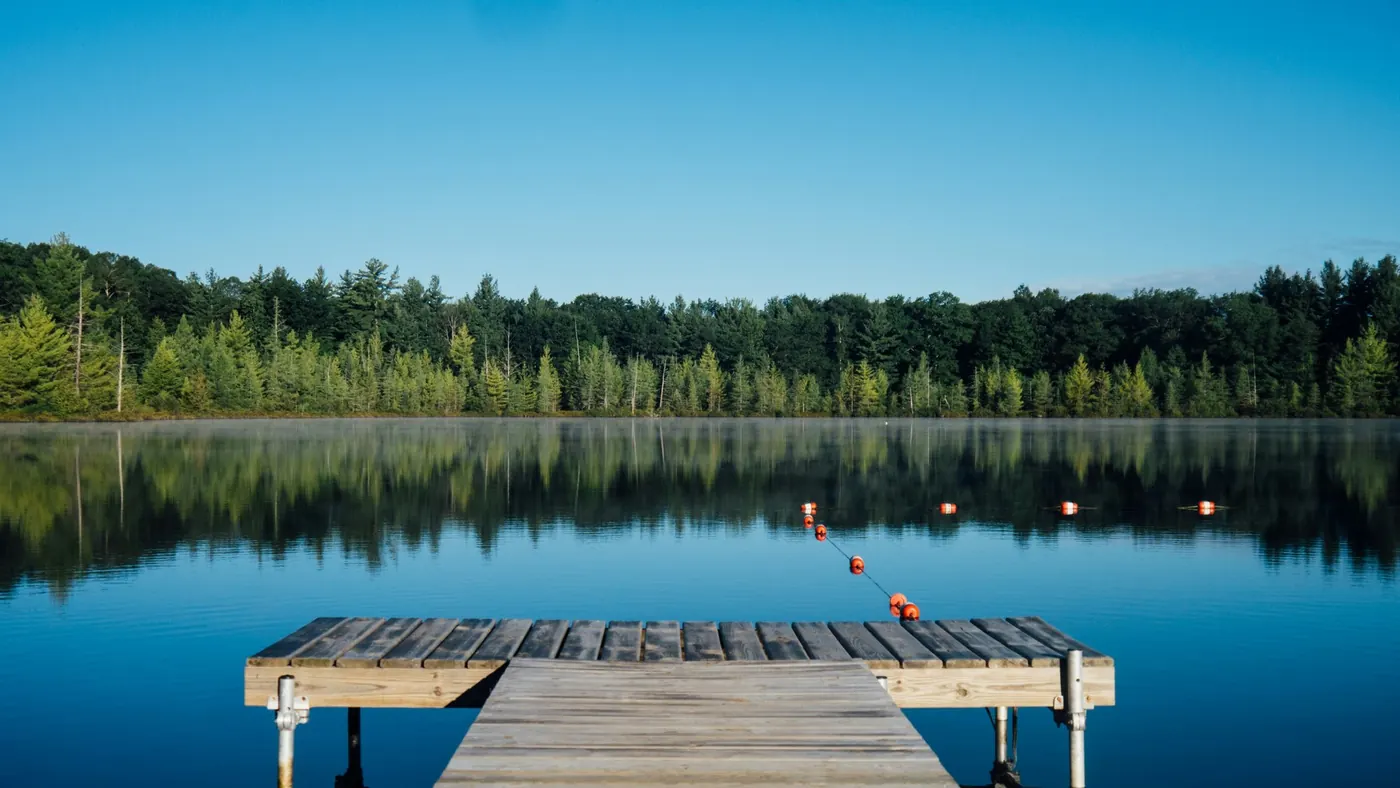
A dock looks like the simplest structure on a waterfront property. It is often the most heavily regulated thing you will own. Dock permits on Lake Simcoe can involve as many as five separate authorities, from the Township of Oro-Medonte through to Fisheries and Oceans Canada, and the provincial trigger begins at a structure in physical contact with more than 15 square metres of shore lands.
A dock on Lake Simcoe can touch five approval layers: municipal zoning and building permits, conservation authority permission under section 28 of the Conservation Authorities Act, a Public Lands Act work permit when a structure contacts more than 15 square metres of shore lands, a self assessment against the federal Code of Practice for docks, moorings and boathouses, and the Canadian Navigable Waters Act, which lists ordinary residential docks as minor works. Small removable seasonal docks are exempt from several of these, but if you rely on Fisheries and Oceans Canada's Code of Practice for docks, DFO asks for a notification 10 working days before work starts. Confirm your own shoreline with the Lake Simcoe Region Conservation Authority and your township before you build, repair or replace anything.
Who has to approve a dock on Lake Simcoe?
Five layers can apply, and none of them replaces another.
The municipality. The Township of Oro-Medonte sets zoning, setbacks and building permits for structures on land, including boathouses, decks and shore stairs. It is also where you confirm whether a public strip sits between the lot line and the water, the same question that drives how shore road allowances work further north.
The conservation authority. The Lake Simcoe Region Conservation Authority is the permitting authority for regulated areas around the lake, including Oro-Medonte and Innisfil. Since April 2024, conservation authority permissions across Ontario have operated under one provincial regulation, O. Reg. 41/24, made under section 28 of the Conservation Authorities Act (Lake Simcoe Region Conservation Authority, n.d.). LSRCA's permit guidance and regulation mapping is the authoritative check for a specific lot.
The province. A work permit is required to construct or place a structure in physical contact with more than 15 square metres of shore lands, under O. Reg. 239/13 made under the Public Lands Act. Ontario issues these shore land work permits without charging for the permit itself (Government of Ontario, n.d.).
Fisheries and Oceans Canada. The Fisheries Act prohibits harmful alteration, disruption or destruction of fish habitat without authorization, and DFO runs a self assessment model for docks through its Code of Practice for docks, moorings and boathouses.
Transport Canada. Under the Canadian Navigable Waters Act, docks and boathouses are listed as minor works, and a minor work meeting the criteria of the Minor Works Order normally proceeds without approval (Government of Canada, 2021). Approval territory begins when a structure substantially interferes with navigation.
Does a small seasonal dock need a permit?
A small removable dock often clears several tests at once, and still leaves you with obligations. Here is where the thresholds sit.
Commonly outside the permit requirement:
- A seasonal or floating dock of 10 square metres or less that needs no permanent support structures and can be removed in the event of flooding is exempt from conservation authority permission under O. Reg. 41/24 (Lake Simcoe Region Conservation Authority, 2024).
- A structure in physical contact with 15 square metres or less of shore lands sits below the provincial work permit trigger.
- Removing an existing dock or boathouse needs no work permit where no dredging is involved.
- Rock placed into cribs is exempt unless the crib contacts more than 15 square metres of shore lands.
- Maintaining, repairing or replacing an existing erosion control structure is exempt but requires registration.
Commonly requiring approval or review: cribbing, fill, dredging, new breakwalls, revetments and groynes on Crown shore lands; boathouses with a second storey or living accommodation; and anything DFO's Code of Practice excludes, which includes construction of new crib docks, foam floats, impact hammer pile driving, removal of natural material below the ordinary high water mark, dredging and fill (Fisheries and Oceans Canada, n.d.).
Here is the part cottagers miss. Where a project fits DFO's Code of Practice for docks, DFO asks for a notification 10 working days before work starts; projects outside the Code need a DFO review instead. A small dock can be exempt provincially, exempt from the conservation authority and a minor work federally, and there is still someone you must notify. No permit needed almost never means no agency needs to hear from you.
Why ice, not paperwork, decides how a dock is built
Lake Simcoe freezes, and spring ice moves. Federal guidance written for cottagers is blunt about the limits of building your way out of that problem: spring ice can tear apart anything you add to a shoreline, including reinforced concrete. That reality, more than any by-law, should drive the choice of dock.
| Dock type | Behaviour in ice | Practical notes |
|---|---|---|
| Floating | Removed seasonally to protect it from ice | Holds constant freeboard as water levels change, and needs adequate depth |
| Pipe or post | Vulnerable to ice, so seasonal removal is expected in a harsh climate | Least costly, minimal submerged contact, poor at creating a sheltered mooring |
| Permanent pile | Stays in, but shifting ice can lift piles right out | Driven to bedrock, professional installation |
| Cantilever or suspension | Anchored to shore, least disruption to the bed | Unsuitable where water levels swing widely |
| Crib | Shifting ice can topple cribs | Large habitat footprint and the heaviest approval burden |
There is a useful convergence here. DFO ranks dock types for fish habitat from most friendly to most damaging as pipe, permanent pile, floating, crib, and concrete piers last, and the conservation authority exemption applies only to removable seasonal docks. The environmental rules and the physics of Ontario ice point to the same answer: removable, minimal footprint structures.
Seasonal removal and spring inspection on the north shore
Exposure varies enormously along a single stretch of shoreline. A dock at Shanty Bay, one at Hawkestone and one tucked into Carthew Bay face different fetch, different wind loading and different ice movement, so the routine should follow the site rather than a generic calendar. When Kimberly walks waterfront along the Lake Simcoe north shore with a buyer, the first dock question is not what it is made of but whether it comes out, and who has been taking it out.
No regulator publishes a removal date. Haul out timing is local practice, judged against the season, and the honest instruction is to have it done before the ice comes in. On an exposed shoreline, small floating and pipe docks come out. Where a system stays in, hinges are disconnected and lines left slack so shifting ice has somewhere to go.
Once the ice is out, work through the structure before anyone walks on it: flotation for waterlogging and cracking, deck boards and stringers, every fastener and bracket for corrosion, cleats, anchors, cables and the approach stairs. Replace corroded hardware with marine grade fittings. Keep chemical application away from the water, and clean, drain and dry anything that moves between lakes.
What the Lake Simcoe Protection Plan means for shoreline work
Lake Simcoe carries a layer that most Ontario lakes do not. The provincial Lake Simcoe Protection Plan sets a minimum 30 metre vegetation protection zone from the shoreline in shoreline built-up areas, or more where an evaluation warrants it, and 100 metres from the shoreline outside settlement areas and shoreline built-up areas.
Two policies matter directly to shoreline structures. Policy 6.7 provides that significant alteration of the shore of Lake Simcoe is not permitted unless the work is for stabilizing, protecting, restoring or rehabilitating the shore. Policy 6.8 provides that no structures, including boathouses, are permitted in Lake Simcoe if the structure impedes water flow, is intended as a dwelling, or harmfully alters fish habitat (Government of Ontario, 2026).
That last one is the plain language answer to a question that comes up every season: a sleeping cabin over the water is not on the table here. Where alteration is permitted, the plan directs owners toward natural shoreline treatments. Designs that work with those policies tend to move through review more smoothly than designs that fight them.
Your sequence before the work starts
Federal guidance for cottagers sets out an order of operations worth following rather than improvising.
- Start with the conservation authority. Check LSRCA's regulation mapping, then request pre-consultation to confirm whether your lot is regulated and whether your concept is exempt.
- Go to the township next. Confirm zoning, setbacks, whether a building permit applies, and whether any public strip affects the shoreline in front of the lot.
- Check the provincial threshold. If the structure will contact more than 15 square metres of shore lands, or involves cribbing, dredging or fill, a work permit applies.
- Self assess against DFO's Code of Practice; if the project fits the Code, send the notification at least 10 working days before work starts, and if it does not, request a DFO review.
- Prepare a scaled site plan showing lot lines, the high water mark, the dock footprint and projection, and distances to the side lot lines, plus construction drawings and an anchoring plan.
- Apply in winter, so reviews clear before the spring construction season (Burns, n.d.).
Common questions
Do I need a permit for a small floating dock on Lake Simcoe?
Often no single permit applies, but that is not the same as no approvals. Ontario's conservation authority regulation exempts a seasonal or floating dock of 10 square metres or less that needs no permanent support structures and can be removed in the event of flooding, and the provincial work permit requirement starts when a structure is in physical contact with more than 15 square metres of shore lands. If the project fits its Code of Practice for docks, Fisheries and Oceans Canada asks for notification 10 working days before work starts, and the Township of Oro-Medonte still sets zoning and building rules. Confirm your own site with the Lake Simcoe Region Conservation Authority before you order materials.
Who owns the lake bed in front of a Lake Simcoe property?
In most cases in Ontario the bed of a navigable water body is presumed to have stayed with the Crown. Under the Beds of Navigable Waters Act, private ownership of the bed requires an express grant, and general wording in an old deed such as together with the woods and waters therein does not count as one. That is why placing a structure on the bed can involve provincial authorization even when the upland lot is privately owned. A real estate lawyer can confirm what a specific title actually includes.
Should I take my dock out of Lake Simcoe for the winter?
For most small floating and pipe docks on an exposed Lake Simcoe shoreline, yes. Federal guidance for cottagers treats floating and pipe systems as seasonal by design and warns that shifting spring ice can tear apart even very heavy structures. No regulator sets a removal date, so the timing is a local judgment call made before the ice forms. Removing a dock does not require a provincial work permit as long as no dredging is involved.
How long do shoreline approvals take near Oro-Medonte?
A clearly exempt seasonal dock can move quickly, while cribbing, dredging, a boathouse or anything occupying the lake bed takes longer because more than one agency reviews it. Federal guidance for cottagers recommends submitting applications in winter so reviews clear before the spring construction season. Build that review time into any closing date or listing timeline. The Lake Simcoe Region Conservation Authority and the Township of Oro-Medonte will each confirm their current processing expectations.
Talk it through before you build
A dock is one of the few improvements where the approval question and the resale question are the same question. If you are weighing a shoreline project, buying a property with an existing dock of uncertain history, or comparing waterfront, water view and water access options on the lake, it helps to map the approvals before the money moves. The same discipline applies to what makes a cottage four season if year round use is part of the plan. You are welcome to book a call with Kimberly and walk through your shoreline before you commit to anything.