

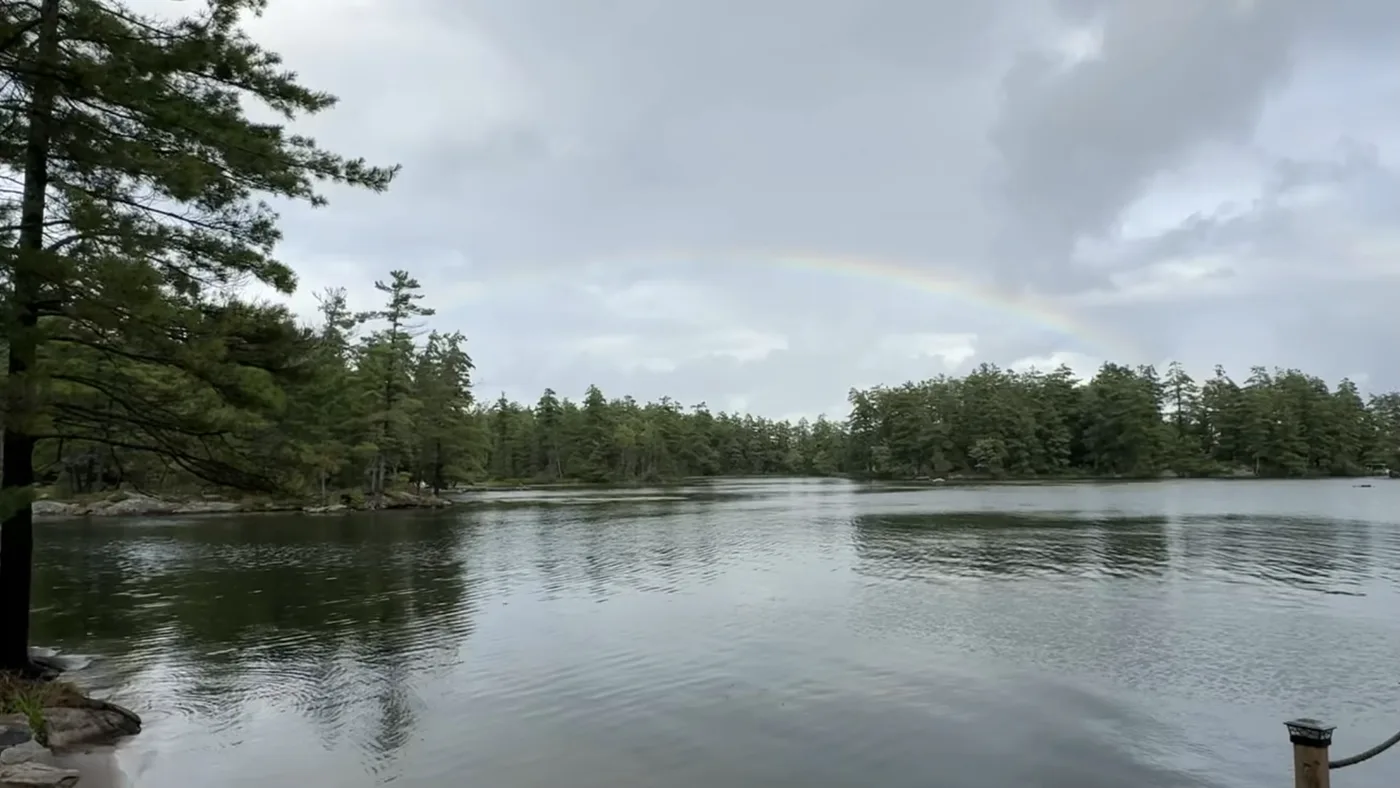
A water-access cottage is one you reach by boat, not by road. You park on the mainland, load the boat and cross to the island or shoreline lot. It takes more planning than driving to the door, and many owners who have had both would not go back. My own cottage is water access, so this is a choice I made myself. Below is why people choose it, and the practical questions to settle before you make an offer.
A water-access cottage is one you reach by boat. Before you buy, confirm in writing where you will park and dock on the mainland, who owns the lake or river bed in front of the lot, which permits cover the dock and boathouse, and the condition of the septic and water systems. Raise financing early: CMHC requires year-round vehicle access, but Sagen's Type B program accepts boat-access cottages.
Why would anyone choose a cottage without a road?
Because just the act of getting onto the boat and leaving the marina changes everything. When I park at the marina and load up the boat, the week stays on the mainland. By the time I reach my own cottage dock, I have already arrived. Fresh air on my face, and breathe...
Owners describe a few things again and again:
- Privacy. There is no road at the door and no cars going by. What you hear and what you see is the water, the trees, and your own little piece of heaven.
- The crossing itself. Ten minutes on the water at the start and end of each visit becomes part of the ritual, not a chore.
- A different pace. You plan meals and supplies ahead, you bring what you need, and you leave the rest behind. Most owners find that is the point.
What is the community like on the water?
This is the part that surprised me most, and it is the hardest to explain to someone who has only had a road-access cottage.
On the water, you get to know your neighbours by their boats. You wave across the bay. When a motor will not start at the marina or the landing, someone stops to help, and next time it is you. The marina and the landing become meeting places where news is shared, extra hands appear for a heavy load, and people look out for each other's property through the off-season.
Road-access cottages have good neighbours too. The difference is that on the water everyone depends on the same marina or landing, the same weather and the same freeze-up, so people tend to rely on each other more. Many owners tell me that is the part they would miss most.
What are the trade-offs?
An honest answer helps you decide, so here they are:
- Everything crosses by boat. Groceries, luggage, building materials and trades all have to come across.
- Weather decides some days. High wind or a storm can mean waiting to cross.
- Shoulder seasons are short or closed. During freeze-up in late fall and break-up in spring, there are weeks when the ice is too thin to cross on and too thick to boat through.
- Costs are different. Mainland parking, marina fees, a reliable boat and its upkeep are part of the cost of ownership.
If those trade-offs sound like part of the appeal, water access may suit how you want to use a cottage.
What should you check before you buy a water-access cottage?
1. Mainland parking and docking, in writing
Every water-access property depends on somewhere to leave a car and a boat. Ask exactly where the current owner parks and docks, and whether that arrangement transfers to you.
- A marina slip or parking spot is, in my experience, usually a separate contract with the marina, not part of the sale. Confirm the cost, the term and whether there is a waiting list.
- A municipal landing may have limits. In the Township of Georgian Bay, for example, some municipal lots have a seven-consecutive-day parking limit, and Port Severn Park does not allow overnight parking (Township of Georgian Bay, n.d.-a). The Township of Muskoka Lakes may require a permit to keep a boat at a municipal dock, with daily, monthly and seasonal fees (Township of Muskoka Lakes, n.d.-a).
- A deeded right of way or a shared private landing should be confirmed by your lawyer on title.
Muskoka Lakes' Official Plan shows how seriously this is taken: where new water-access lots are allowed without a public road, adequate long-term parking and docking must be secured to the Township's satisfaction (Township of Muskoka Lakes, n.d.-b). That rule applies to creating new lots, but it is a good test for any purchase. If the parking and docking are not secure, neither is your access.
2. Who owns the water in front of the cottage
The bed of the lake or river is often not part of your lot.
- On the Trent-Severn Waterway, which includes the Severn River, Sparrow Lake and Gloucester Pool, Parks Canada owns and has jurisdiction over the bed of the waterway, up to the original upper controlled water level. A title search shows where a particular lot ends (Parks Canada, 2026).
- On most other navigable lakes and rivers in Ontario, the bed is Crown land under the Beds of Navigable Waters Act, unless it was expressly granted (Ontario Ministry of Natural Resources, 2026b).
This matters because docks, boathouses and shoreline work sit on land you may not own, so they need approval from whoever does. If there is a road allowance along the shore, that adds another layer; see my guide to shore road allowances.
3. Dock, boathouse and shoreline permits
Your dock is your driveway, so its permits matter more than on a road-access lot.
- On the Trent-Severn Waterway, Parks Canada requires a permit for all work on, under and over the bed and waters, including installing, repairing or replacing docks, boathouses, boatlifts and shoreline stabilization. No existing in-water structure is grandfathered, so a replacement must meet current policy, and Parks Canada advises applying several months before the work starts (Parks Canada, 2026).
- Water-access lots get an extra dock. Parks Canada's policy allows one dock for a road-access property and two for a water-access-only property (Parks Canada, 2026).
- Your township has its own permit. In the Township of Severn, a building permit is needed for most docks, boathouses and boat ports (some small floating or pole docks off the waterway are exempt), and on the Trent-Severn the Parks Canada permit must come first (Township of Severn, n.d.-a). Off the waterway, a Crown land work permit may also be needed for structures in contact with more than 15 square metres of Crown shore lands; floating docks do not count toward this (Ontario Ministry of Natural Resources, 2026a).
Before you offer, ask for copies of any permits for the existing dock and boathouse, and ask the township and Parks Canada whether there are open orders.
4. Septic system
Getting a septic contractor and equipment to an island is harder and costs more, so the system's condition matters.
- The township issues septic permits. The Township of Georgian Bay is the authority for septic systems in its area, and the Township of Severn issues septic permits through its building department (Township of Georgian Bay, n.d.-b; Township of Severn, n.d.-c).
- Ask for the permit history and any inspection records. Re-inspection programs vary by township. In Severn, the mandatory program applies only within its wellhead and intake protection areas, and the Township suspended its discretionary waterfront program in June 2026 (Township of Severn, n.d.-b). The Township of Georgian Bay runs discretionary re-inspections of waterfront properties, including water-access lots (Township of Georgian Bay, n.d.-b). Ask, and do not assume a recent inspection exists.
- Make a septic inspection a condition of your offer.
5. Drinking water
Many water-access cottages draw water from the lake. Ontario notes that lakes and rivers have no natural layer to filter out microorganisms, so water that may be affected by surface water needs effective filtration and treatment (Ontario Ministry of Agriculture, Food and Agribusiness, 2026).
- Ask what treatment system is in place, how old it is and when filters and lamps were last changed.
- Public Health Ontario offers free bacteria testing for private drinking water, including treated lake water. Sample kits are available from public health units (Public Health Ontario, 2025). The test covers bacteria only, not chemicals.
6. The boat
You will need a boat suited to the crossing and the load, and anyone operating a motorized boat for recreation needs proof of competency, such as the Pleasure Craft Operator Card (Transport Canada, 2024).
7. Financing and insurance
Raise both early, because water access can change the answers.
- CMHC's second-home mortgage insurance requires a property suitable for year-round occupancy with year-round vehicular access. For an island, that means a vehicular bridge or ferry (Canada Mortgage and Housing Corporation, n.d.). Many water-access cottages will not meet that test.
- Sagen's Vacation/Secondary Home program is the exception to know about. Its Type B (Vacation Homes) category accepts a property that is accessible only by boat, does not need to be winterized or have a permanent heat source, and allows a loan of up to 90% of the property's value, subject to credit and property-value limits (Sagen, n.d.). Its Type A category, like CMHC's, requires year-round road access.
- Not every insurer offers this. Canada Guaranty's second-home program, for example, does not accept island properties without bridge access (Canada Guaranty, 2025).
- Lenders set their own criteria on top of the insurer's, so please speak with a licensed mortgage professional about your situation before you make an offer.
- Insurance: in my experience, insurers ask about fire protection, heating, access and how often the property is checked. Get a quote before your conditions expire.
8. Off-season access
Ask how the current owner checks on the property between freeze-up and break-up. Never cross ice you have not confirmed is safe. The Canadian Red Cross recommends at least 15 cm of ice for walking or skating alone, notes that clear blue ice is strongest and warns that grey ice is not safe (Canadian Red Cross, 2016). Many owners simply plan around the weeks when crossing is not possible. For closing up, see my post on winterizing a water-access cottage before closing.
Common questions
Can you get a mortgage on a water-access cottage?
It can be. CMHC's second-home insurance requires year-round vehicular access, but Sagen's Vacation/Secondary Home program has a category (Type B) that accepts boat-access properties, with a loan of up to 90% of the property's value, subject to credit and property-value limits. Lenders add their own criteria, so speak with a licensed mortgage professional before you make an offer.
Do you need a permit for a dock at a water-access cottage?
Usually. On the Trent-Severn Waterway, Parks Canada requires a permit for docks and other in-water work, and your township may require a building permit as well. Elsewhere, a Crown land work permit may be needed for larger structures.
How many docks can a water-access cottage have on the Trent-Severn?
Parks Canada's policy allows two docks for a water-access-only property and one for a road-access property, subject to its size and design rules.
Where do you park for a water-access cottage?
Usually at a marina, a private landing or a municipal lot. Confirm the arrangement in writing before you buy, because some municipal lots limit how long you can park.
Is a water-access cottage harder to sell?
The pool of buyers is smaller, because not everyone wants to cross by boat. The buyers who do want water access are often specifically looking for it, so pricing and marketing to them matters.
Is water access right for you?
If the idea of loading the boat on a Friday night sounds like the start of something good, it may be. If you would like to talk through a specific lake or property, including the Severn River, Sparrow Lake, Gloucester Pool or Georgian Bay, I am happy to help. You can also explore my lake guides for the Severn River, Sparrow Lake, Gloucester Pool and Six Mile Lake.